Ceramics Monthly Interview: Unpredictability and Balance: The Work of Nina Gerada
Nina was interviewed for the January 2025 Ceramics Monthly magazine
read the full interview here
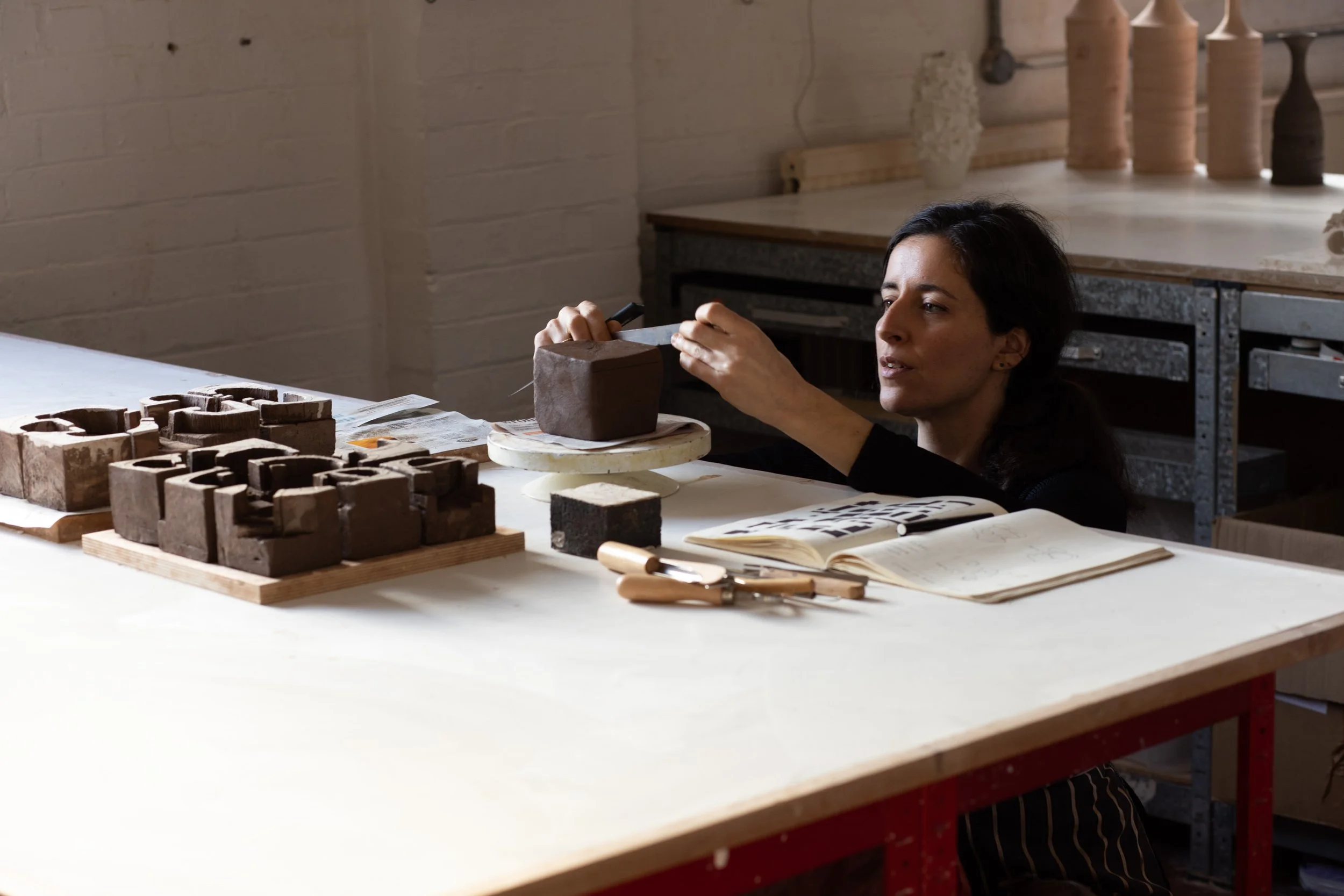
Nina in her studio in North London, 2021
Nina Gerada doesn’t consider herself solely a ceramic artist because she’s interested in a range of materials and works at a variety of scales, including spatial projects. “The greatest skill I have learned is to develop a growth mindset and to see failure as an opportunity for improvement—these are not ceramic-specific skills, however, clay does teach you this,” she says.
Gerada, who is currently participating in the Malta Art Biennale notes, “It was the first ever art biennale in Malta and my first time exhibiting in my home country.” She showed 170 goddesses as part of the Matri-Archive of the Mediterranean section of the main pavilion. She is also collaborating with ceramic artist Caz Hildebrand on an ambitious project that they have been developing with handmade brickworks.
One of 24 artists to be selected to take part in the British Ceramics Biennale “Fresh” exhibition in Stoke-on-Trent in 2023, she was chosen from over 300 applications, “which does feel like a great achievement.” Gerada has exhibited with Thrown Contemporary, most notably at “Collect” in 2022 and 2023 at Somerset House, London.
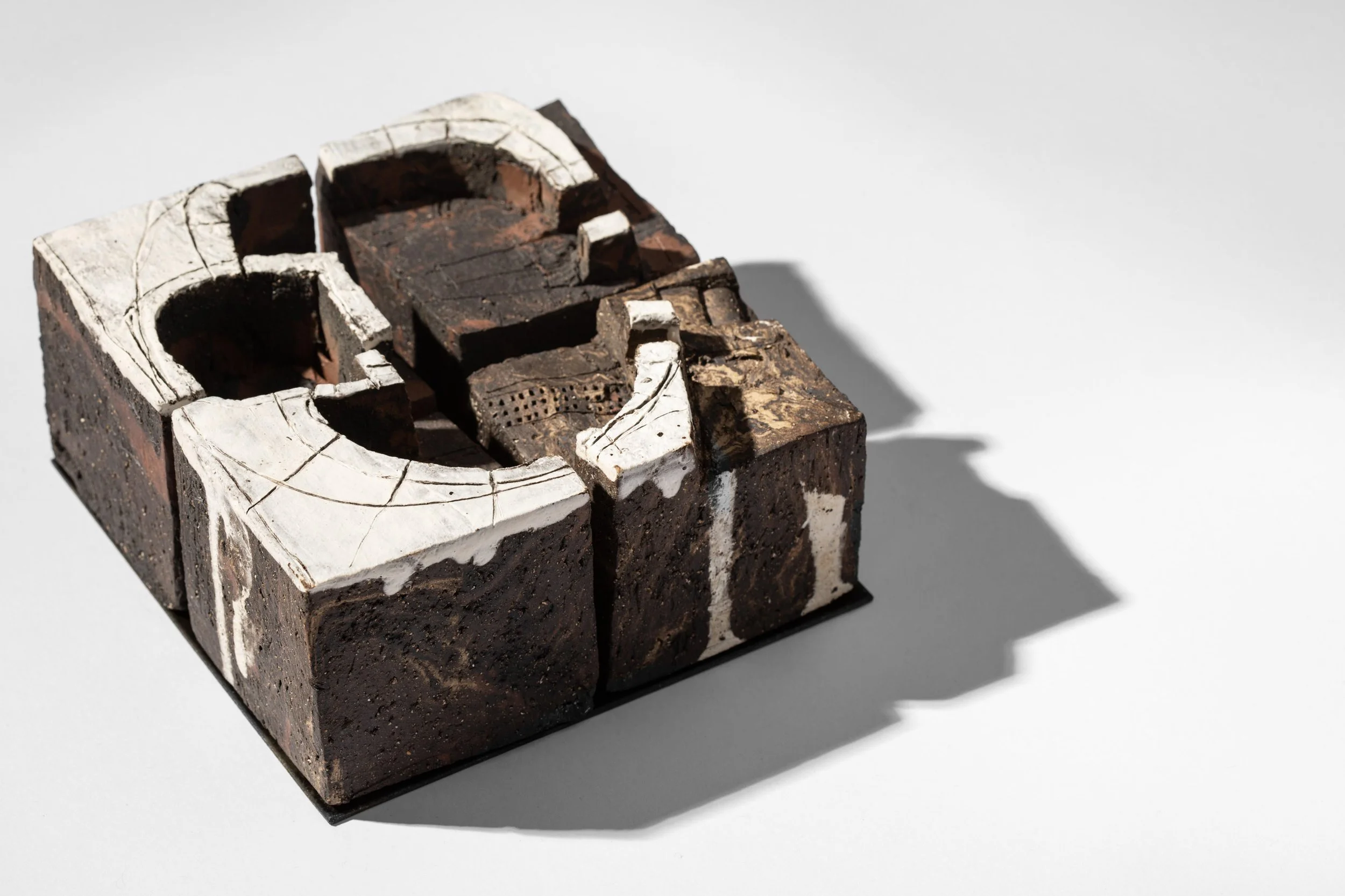
Enclose, 2020
Starting out making vessels, she played with cutting the edges with a piece of fishing wire. “The functionality mattered less and less, but the materiality of the clay and how it reacted to being carved became very interesting to me,” says Gerada. “I was making associations between the cut clay and the carved limestone spaces of my homeland, Malta. I decided to pursue carving clay and memories further and so I began to make sculptures instead of functional pieces.” Each piece has a story. “Often stories of places, people, and the body appear in my work.”
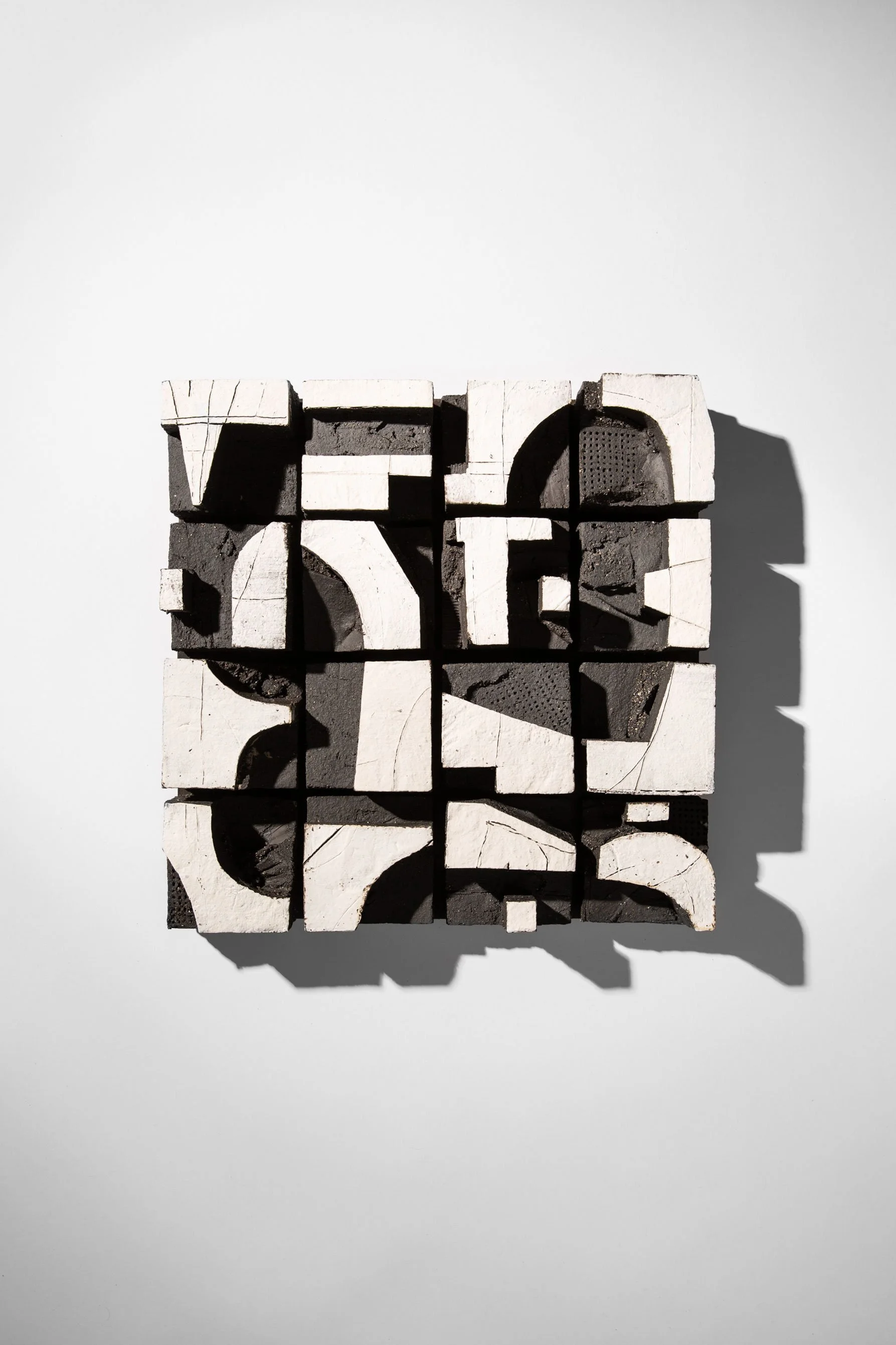
Meet Me Here, 2020
Currently making large coil, slab, and pinch-pot enclosed shapes, she is enjoying the unpredictability of this mixed process. Although trained as an architect, Gerada does not draw the specific outcome she is after. “Instead, I hold inspiring images close by as I make. I tend to collect images. These might be of archaeological digs, city maps, the female form, bricks, typesetting blocks, rocks, fossils, and I often collage and draw over them.”
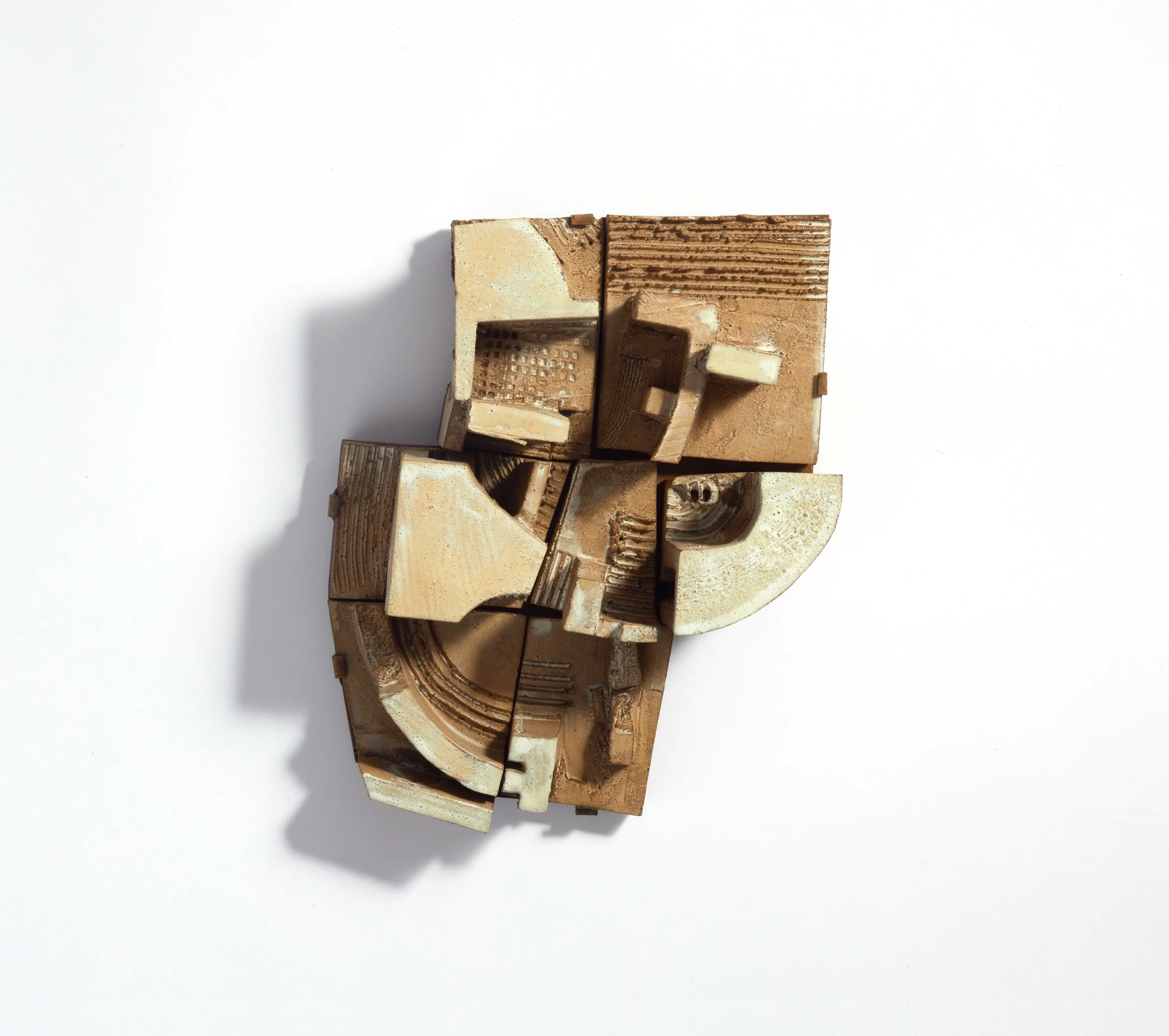
Gold 1, 2022
As Gerada works her way through different ideas and projects, the processes she uses change. “For a long time, I was making clay blocks, painting them with slip, and then drawing and carving into them. It was important to me that my process echoed the carved limestone spaces of my childhood in Malta,” she says, adding that she was making hundreds of pieces. This was a way of testing ideas without feeling precious. “Following firing many parts, I’d reconfigure and reposition, searching for balance between solid and void.”
Lately, she has been collaborating on a project, which has involved making plaster molds and slip casting fossils. “I’ve also been making large-scale coiled figurative sculptures and experimenting with insertions of shells and rocks into the clay.”
A range of clays are used, depending on what is being made, which has included, but is not limited to: unprocessed wild clay, black stoneware clays, slip-cast porcelain, and terra cotta.
Growing up in Malta in the 1980s and 90s was a creative place for Gerada. “People made and mended things,” she recalls. “My grandmother was renowned for her skill in matching color by dying fabrics. She also made and decorated wedding cakes and bridal wear. One grandfather made replica Victorian furniture, the other was a Dante expert. My father sailed in the summers and fixed his boat during the winters, and my mother sewed clothes for us. As a child I remember spending a lot of time hanging around as people fixed and made things: at tailors, boat yards, panel beaters, mechanics, coffee grinders, cobblers.”
Gerada learned the basic techniques from the artist Lewis Wirth, who specialized in drawing and painting the Maltese landscape and seascape, focusing on wayside chapels and the areas around St. Julians’, Balluta, and St. Paul’s Bary. Gerada knew of some renowned Maltese ceramic artists like Gabriel Caruana and Paul Haber. “Role models came later as I developed my own language. These include the artists that follow. Patricia Sannit, who makes objects, large-scale sculptures, and installations that originate from research into human universals. Anabelí Diaz, who strives to show that every human being is a universe of their own through her large-scale figures. Aneta Regel creates abstract ceramic sculptures that emulate the natural world around her. Lubna Chowdhary, who through her often vibrantly colored ceramics, paintings, and works on paper, explores the intersections of culture.
Moving to London at age nineteen, she studied art, design, and architecture. Working in architecture, production design for film, and urban design as well as teaching various design courses, in 2017, Gerada began renting a desk in a communal ceramics studio in North London. She recently moved to Malta after twenty years in the UK.
She credits weekend pottery classes with developing her passion for the medium. “When I was a child, I used to spend Saturday mornings at pottery classes with many friends in a local ceramic artist’s garage studio. It was a lot of fun because she supported us in anything we wanted to make whilst teaching us traditional techniques.”
Gerada has received a range of education in art and design from formal qualifications to more classic internship-style learning. In ceramics, she is self-directed and learns a lot from the skill share of the studio community and supplements her learning with part-time courses at Clay College and Morley College to deepen her knowledge.